viernes, 29 de enero de 2016

OBJECTIVES

TIPS FOR WRITING OBJECTIVES

Objectives are the most important features in a lesson plan since they describe what teachers expect students be able to do. However, writing an objective is not as easy as it seems, it requires knowledge of bloom´s taxonomy so then the teacher could identify the learning level of the lesson objective.

There are three types of objectives. First it is the cognitive, it seeks students´ understanding. The second it is the psychomotor, it looks for students movements and the last one is the affective it involves students feelings. Objectives could be written in a specific or general way but their purpose is the same. They are written to ensure and clarify what the lesson is going to be about and what students´ outcomes will be.

Regarding the main information about objectives, I would write my lessons´ objectives in an appropriate way by using bloom´s taxonomy. It definitely will help to choose the correct action verb based on what I want to measure from my students that could be their comprehension, knowledge, application, evaluation so on.


To sum up, there are some tips that can help teachers to write perfect objectives for their classes. Moreover, it is necessary to take into account the words and phrases which are not measurable and must be avoided. 


REFERENCE

Acep.org,. (2016). Retrieved 29 January 2016, from https://www.acep.org/uploadedFiles/ACEP

YouTube,. (2016). VideoScribe - Writing Learning Objectives. Retrieved 29 January 2016, from https://www.youtube.com/watch?v=eXxTpDg1thI

BLOOM´S TAXONOMY

BLOOM´S TAXONOMY

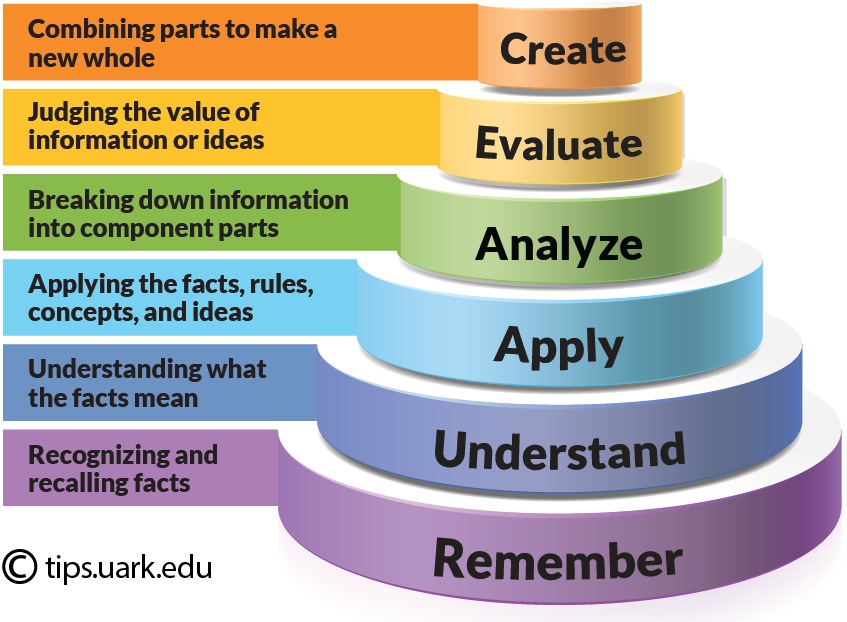
The creator of this taxonomy was Benjamin Bloom with the purpose of providing teachers the levels of test questions that they usually use in a classroom. Those kind of questions evaluate students´ understanding when we they receive input in any case that could be activities that involve reading or listening the language. The levels could be divided by competences like:    

COMPETENCE
VERBS
QUESTIONS
ACTIVITIES
Knowledge
define, describe,tell
Can you tell me why?
Make a facts chart
Comprehension
Summarize, differ
What was the key?
Perform a play based on the reading
Application
Apply, illustrate
Can you apply the method
Dress a doll in national costume
Analysis
Analyse, explain
How was it similar to?
Conduct an investigation
Synthesis
Create, design
Can you see a solution?
Design a building
Evaluation
Assess, test, judge
Do you believe?
Write a report

Personally, I would regard the questions competences in order to develop activities. For instance, when my students need to complete a reading exercise so then I would evaluate their comprehension of the text by asking them previously the activity. What was the main idea of the text?. After that I would ask them to complete a task based on their reading comprehension.   

In short, as we could see for each competence useful verbs are provided as well as potential activities. Through the chart above I can easily identify the questions with their respective activities. It is useful to know how questions can work through their purposes.

See this pyramide that best describes Bloom´s taxonomy.

REFERENCE

Atherton, J. (2016). Bloom's taxonomy.Learningandteaching.info. Retrieved 29 January 2016, from http://www.learningandteaching.info/learnin

http://www.coun.uvic.ca/learning/exams/blooms-taxonomy.html

jueves, 28 de enero de 2016

LESSON STUDY METHODOLOGY

LESSON STUDY

Lesson study is a popular process of teacher professional development in which planning, observation and teachers´ feedback are immersed.

All it needs is a group of teachers who plan a lesson together with its respective goals, then only one member of the group is going to carry out the lesson while the others´ role is to be active observers and to criticize the whole lesson development. At the end everybody will give feedback and possible changes regarding the strengths and the weaknesses found out.

This methodology provides me many benefits which I will take advantage for my future classes. Since the participation of other teachers is needed, I will ask my closer colleagues to evaluate my work and give me recommendation.


In short, lesson study is a great tool to enhance content and acquire pedagogical knowledge. Through that I could have the chance to reformulate activities, adapt materials, add or omit extra resources.  

}

REFERENCE

Ets.org,. (2016). Retrieved 27 January 2016, from https://www.ets.org/flicc/pdf/Nov4Lesson

Es.slideshare.net,. (2010). Lesson Study (No Pic) Benefits And Misconceptions (25 2 10). Retrieved 27 January 2016, from http://es.slideshare.net/mgcpenang/lesson-study-no-pic-benefits-and-misconceptions-25-2-10

UNIT 29

CATEGORISING LEARNERS´ MISTAKES

Mistakes are frequently made by EFF learners in the learning process. It is common to find them when learners tend to produce the language.

Within this unit is described the subdivision of mistakes. Those could be errors or slips. When a learner second-language production is interfered by his first language (L1 interference), it is considered as an error so that he cannot correct himself. It could happen because of his lack of knowledge. However, when a second language learner make slips is because of his lack of concentration or tiredness so that that could be corrected by himself.  

As a teacher I found out in my classes, different kind of mistakes that the students committed. For instance when they wanted to ask a question orally, they used to pronounce wrongly certain words like the auxiliary does for the third person. Most of the time they mispronounced words, but it is not just a matter of pronunciation but grammar, lexis and register. Moreover, my students also used to make mistakes when writing and they had the same problem all the time.

In short, based on my observation for my future plans I would try to fight against those committed mistakes with effective strategies in order to avoid fossilization. And it could be through the application of self or peer correction. The thing is that I cannot prohibit my students´ mistakes but I can reduce the inappropriate production of those mistakes.

Here you have a video showing the best way to correct errors in speaking. 


REFERENCE 


User, S. (2016). Heads Up English | ESL Lessons - How to Correct: Four Ways to Handle MistakesHeadsupenglish.com. Retrieved 28 January 2016, from http://www.headsupenglish.com/index.php/esl-articles/feedback-and-correction/314-how-to-correct-esl-students

YouTube,. (2016). Error Correction in Speaking - The Fun Way: Herbert Puchta (Teaching Teenagers Tip #4). Retrieved 28 January 2016, from https://www.youtube.com/watch?v=znswuO4goYg


miércoles, 27 de enero de 2016

UNIT 28

IDENTIFYING THE FUNCTIONS OF LEARNERS´ LANGAUGE

What I learnt in this unit was the different functions used by learners in the classroom. Some possible language functions are; greeting, asking for clarification, agreeing, speculating, self-correcting and between others.

Within a lesson a student can use many of them depending on his needs, age, level and the learning context. For example, when having a quiz a beginner might have some doubts about the instructions given in the test so he will use the function of asking clarification or expressing doubt. For that he will need to use exponents so those exponents must be taught in advanced so that he could interact correctly with each other and with the teacher. Bearing in mind all those aspects I will implement the use of exponents in my class. I think the most function used for beginners is asking for clarification. I could identify it when doing my internships. Although the function is identified, beginners never use English exponents. That is why for my future teaching I will teach my student basic exponents depending on their necessity. For instance, if they want to confirm answers from an exercise, I will model the exponent “Is that ok?”, “What is the correct one?”.

In short, learners must know the most frequent exponents but not regarding their grammatical form but their meaning.

Take a look to this video to get familiar with the functions of language.


REFERENCE


YouTube,. (2016). Functions of Language. Retrieved 27 January 2016, from https://www.youtube.com/watch?v=VVUSMFggeww

Finchpark.com,. (2016). Retrieved 27 January 2016, from http://www.finchpark.com/courses/tkt/Unit

UNIT 27

USING LANGAUGE APPROPRIATELY FOR A RANGE OF CLASSROOM FUNCTIONS

In this unit I could identify different classroom functions of teacher language and their exponents.

One of the functions I could clearly remember is instructing. As the word already describes, the teacher give students’ instructions. Those could be given before, during and after developing an activity. Moreover, another classroom function I got quickly was prompting. This function helps learners think, remember, figure out, work out or produce a word, a phrase or an idea. At the moment to prompt, we as teachers usually provide our students short unfinished phrases I order to make our students finish it for us. I remember that I used to use this function in almost all my classes since nobody wanted to take risks by giving a wrong answer, so I helped them by writing on the board non-ended statements. For instance, I like..... or I dislike…….. because…….. Then, they felt more confident to complete that idea by using their own vocabulary. In spite of those functions there are other like modelling, encouraging, nominating and so on.

All these functions are very well known in a classroom so personally I will continue using mainly prompting because I proved that it really works for learners who want to be more active and more participative in the class. 


RESOURCE

YouTube,. (2016). Demo Class ESL Teacher China. Retrieved 27 January 2016, from https://www.youtube.com/watch?v=JUD3DSD8T6U

viernes, 15 de enero de 2016

UNIT 26

SELECTION AND USE OF TEACHING AIDS

In this unit I acquired some knowledge about teaching aids and their purposes in the classroom. Some of the aids are known as classroom equipment and others which for me could be teachers´ resources

Within the first category we have a board, an overhead projector, a CD player, a DVD player, a computer and/or a language laboratory. From all these items I would avoid teenager students to use computers, even though each of them owns one. Because they get distracted easily and usually they prefer to do other things like exploring in the net. However, there are others aids in the second category like realia, flashcards, puppets, charts and the teacher himself/herself. Those are absolutely controlled and sometimes created by the teacher depending on the lesson. In a real situation I had already worked with flashcards and sometimes realia so if I had the chance of working with children I would work with puppets. All the aids mentioned above have their purpose when teaching but I can say that their main purpose is to introduce input to our students in order to reach the class outcome. 

To sum up, in order to include any aid in a lesson, the teacher must select and use it correctly regarding its purpose

Classroom equipment 


Teacher resources


REFERENCE

Es.slideshare.net,. (2016). Teaching Aids. Retrieved 16 January 2016, from http://es.slideshare.net/deepati1/teaching-aids-39749045

Teaching.com.au,. (2016). Modern Teaching Aids - Australia's largest supplier of educational resources. Retrieved 16 January 2016, from http://www.teaching.com.au/